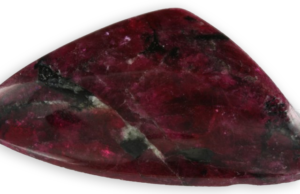
eudialyte
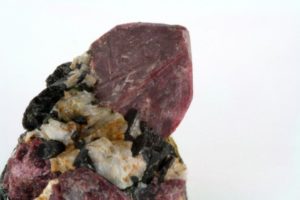
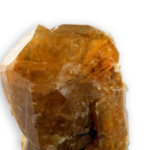
eudialyte crystal from Greenland
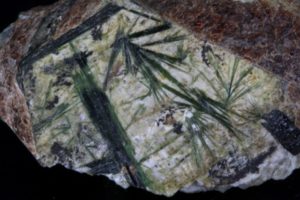
green aegirine on pink eudialyte from Kola Peninsula in Russia
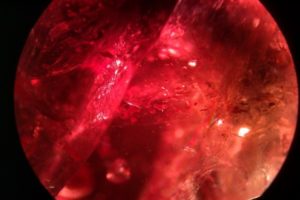
solid like inclusions and split


CHEMICAL CHARACTERISTICS
Na4(Ca,Ce,Fe)2Zr[Si6O17](OH,Cl)2
complex silicate

PHYSICAL CHARACTERISTICS
Main color
pink
Other colors
brown, red, green, purple
Color of streak
white, pink
Luster
vitreous
Hardness
5.0 to 5.5
Density
2.72 to 2.99
Cleavage
indistinct
Fracture
uneven

OPTICAL PROPERTIES
Transparency
translucent, transparent
Refractive index
1.590 - 1.633
Double refraction
0.003
very weak, uniaxial (+)
visible double refraction
No
Dispersion
-
Pleochroism
very weak
Number of colors
2
colorless, pink
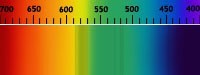
red eudialyte spectrum system
Fluorescence
variable
sometimes red

CRYSTALS PROPERTIES
tabular and massive granular agregates
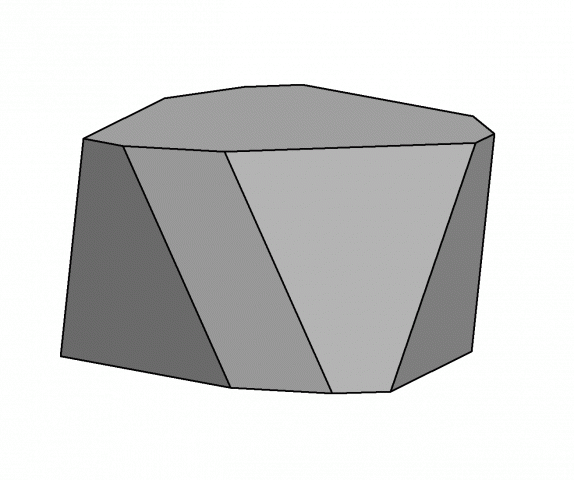
crystals system
trigonal

OTHER INFORMATIONS